



Adrenergic Receptor
Beta Receptor
Adrenergic receptors are a class of G protein-coupled receptors that are targets of the catecholamines, especially norepinephrine and epinephrine. Many cells possess these receptors, and the binding of a catecholamine to the receptor will generally stimulate the sympathetic nervous system. The sympathetic nervous system is responsible for the fight-or-flight response, which includes widening the pupils of the eye, mobilizing energy, and diverting blood flow from non-essential organs to skeletal muscle. There are two main groups of adrenergic receptors, α and β, with several subtypes. α receptors have the subtypes α1 and α2. β receptors have the subtypes β1, β2 and β3. All three are linked to Gs proteins, which in turn are linked to adenylate cyclase. Agonist binding thus causes a rise in the intracellular concentration of the second messenger cAMP. Downstream effectors of cAMP include cAMP-dependent protein kinase (PKA), which mediates some of the intracellular events following hormone binding.
Adrenergic Receptor Isoform Specific Products
All Product Categories
-
Adrenergic Receptor Inhibitors
(267)
View all products
-
Adrenergic Receptor Agonists
(502)
View all products
-
Adrenergic Receptor Antagonists
(545)
View all products
-
Adrenergic Receptor Activators
(45)
View all products
-
Adrenergic Receptor Modulators
(19)
View all products
-
Adrenergic Receptor Degrader
(1)
View all products
-
Adrenergic Receptor Controls
(8)
View all products
-
Adrenergic Receptor Substrates
(3)
View all products
-
Adrenergic Receptor Ligands
(17)
View all products
-
Adrenergic Receptor Related Products (1622)
Related Products (1622)

-
Antibodies (4)
-
Adrenergic Receptor Isoform Comparison
-
Guanfacine-13C,d5 hydrochloride
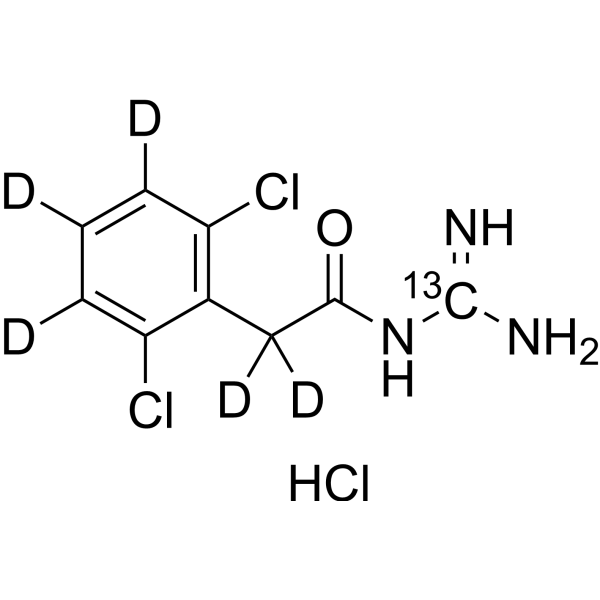 0 ImagesCat. No.: HY-17416S2Guanfacine-13C,d5 hydrochloride is the deuterium and 13C labeled Guanfacine hydrochloride (HY-17416). Guanfacine hydrochloride is an orally active noradrenergic α2A agonist and has high selective for the α2A receptor subtype. Guanfacine has effects in producing hypotension and sedation. Guanfacine can be used for the research of a variety of prefrontal cortex (PFC) cognitive disorders, including tourette's syndrome and attention deficit hyperactivity disorder (ADHD).
-
Levobetaxolol hydrochloride (Standard)
 0 ImagesSynonyms: (S)-Betaxolol hydrochloride (Standard); AL-1577A (Standard)Levobetaxolol (hydrochloride) (Standard) is the analytical standard of Levobetaxolol (hydrochloride). This product is intended for research and analytical applications.
-
(S)-Alprenolol hydrochloride
 0 ImagesCat. No.: HY-121692BCAS No.: 15132-12-4(S)-Alprenolol hydrochloride is a potent and nonselective β-blocker.
-
Propafenone (Standard)
 0 ImagesSynonyms: SA-79 (Standard)Propafenone (Standard) is the analytical standard of Propafenone. This product is intended for research and analytical applications. Propafenone (SA-79), a sodium-channel blocker, acts an antiarrhythmic agent. Propafenone also has high affinity for the β receptor (IC50=32 nM). Propafenone blocks the transient outward current (Ito) and the sustained delayed rectifier K current (Isus) with IC50 values of 4.9 μm and 8.6 μm, respectively. Propafenone suppresses esophageal cancer proliferation through inducing mitochondrial dysfunction and induce apoptosis.
-
Burimamide
 0 ImagesCat. No.: HY-124517CAS No.: 34970-69-9Burimamide is a blocker of histamine H2-receptor. Burimamide inhibits gastric acid secretion evoked by Pentagastrin (HY-A0261) or Gastrin. Burimamide also has alpha-adrenoceptor blocking activity. Burimamide in combination with the H1-receptor antagonist Mepyramine (HY-B1281) shows anti-inflammatory activity in a rat paw edema model induced by Compound 48/80 (HY-115768).
-
Atenolol-13C6
 0 ImagesCat. No.: HY-17498S3Synonyms: (RS)-Atenolol-13C6Atenolol-13C6 ((RS)-Atenolol-13C6) is 13C labeled Atenolol. Atenolol ((RS)-Atenolol) is a cardioselective β1-adrenergic receptor blocker, with a Ki of 697 nM at β1-adrenoceptor in guine pig left ventricle membrane. Atenolol can be used for the research of hypertension and angina pectoris.
-
YM-430
 0 ImagesCat. No.: HY-19115CAS No.: 153192-22-4YM-430 is an oral active calcium entry-blocking and beta-adrenoceptor-blocking agent. YM-430 inhibits Amifampridine (HY-14946)-induced rhythmic contractions with an IC50 value of 59.2 nM and inhibits arginine vasopressin-induced ST-segment depression with an IC50 value of 36.6 mg/kg. YM-430 can be used for study of angina pectoris.
-
Midaglizole (Standard)
 0 ImagesCat. No.: HY-148529RCAS No.: 66529-17-7Synonyms: (±)-DG5128 free base (Standard); DG5128 free base (Standard)Midaglizole (Standard) is the analytical standard of Midaglizole. This product is intended for research and analytical applications. Midaglizole ((±)-DG5128 free base; DG5128 free base) is a potent α2-adrenoceptor antagonist. Midaglizole is a hypoglycemic agent. Midaglizole increases blood pressure and reduces blood glucose levels in vivo.
-
Asenapine-d3,13C
 0 ImagesCat. No.: HY-10121S4CAS No.: 1217729-73-1Synonyms: Org 5222-d3,13CAsenapine-d3,13C (Org 5222-d3,13C) is deuterium and 13C labeled Asenapine. Asenapine (Org 5222), an atypical antipsychotic, is an antagonist of serotonin receptors (pKi: 8.4-10.5), adrenoceptors (pKi: 8.9-9.5), dopamine receptors (pKi: 8.9-9.4) and histamine receptors (pKi: 8.2-9.0). Asenapine can be used in the research of schizophrenia and bipolar disorder.
-
L-765314 (Standard)
 0 ImagesL-765314 (Standard) is the analytical standard of L-765314 (HY-101385). This product is intended for research and analytical applications. L-765314 is a potent and selective α1b adrenergic receptor antagonist with Kis of 5.4 nM and 2.0 nM for rat and human α1b adrenergic receptor, respectively.
-
Formoterol O-β-D-glucuronide
 0 ImagesCat. No.: HY-137909CAS No.: 615551-59-2Formoterol O-β-D-glucuronide is a metabolite of Formoterol (HY-B0010). Formoterol is a potent, selective and long-acting β2-adrenoceptor agonist.
-
Piperoxan hydrochloride (Standard)
 0 ImagesCat. No.: HY-100850RCAS No.: 135-87-5Synonyms: Benodaine hydrochloride (Standard)Piperoxan (hydrochloride) (Standard) is the analytical standard of Piperoxan (hydrochloride) (HY-100850). This product is intended for research and analytical applications. Piperoxan (Benodaine) hydrochloride is an α2 adrenoceptor antagonist. Piperoxan hydrochloride is the first-generation antihistamine.
-
Salmeterol (Standard)
 0 ImagesSynonyms: GR33343X (Standard)Salmeterol (Standard) is the analytical standard of Salmeterol. This product is intended for research and analytical applications. Salmeterol (GR33343X) is a potent and selective human β2 adrenoceptor agonist. Salmeterol shows potent stimulation of cAMP accumulation in CHO cells expressing human β2, β1 and β3 adrenoceptors with pEC50s of 9.6, 6.1, and 5.9, respectively.
-
Buflomedil hydrochloride (Standard)
 0 ImagesBuflomedil hydrochloride (Standard) is the analytical standard of Buflomedil hydrochloride (HY-B0484). This product is intended for research and analytical applications. Buflomedil hydrochloride (Standard), a vasodilator agent, is an orally active α1A-adrenoceptor antagonist with Kis of 4.06 µM and 6.84 µM for α1A-AR and α1B-AR, respectively. Buflomedil hydrochloride can be used for the study of peripheral circulatory disorders.
-
Tamsulosin-d4
 0 ImagesCat. No.: HY-B0661SCAS No.: 1231943-97-7Synonyms: (R)-(-)-YM12617 free base-d4; LY253351 free base-d4Tamsulosin-d4 ((R)-(-)-YM12617 (free base)-d4) is deuterium labeled Tamsulosin. Tamsulosin ((R)-(-)-YM12617 free base) is an inhibitor of α1-adrenergic receptor. Tamsulosin is used for the research of prostatic hyperplasia. Tamsulosin attenuates abdominal aortic aneurysm growth in animal models.
-
Isoxsuprine
 0 ImagesIsoxsuprine is a beta-adrenergic receptor agonist with Kis of 13.65 μΜ and 3.48 μΜ for myometrial and placcntal beta-adrenergic receptor, respectively. Isoxsuprine hydrochloride is also a NMDA receptor antagonist.
-
Gramine-d2
 0 ImagesCat. No.: HY-N0166SCAS No.: 95415-84-2Synonyms: Donaxine-d2Gramine-d2 is the deuterium labeled Gramine. Gramine (Donaxine) is a natural alkaloid isolated from giant reed, acts as an active adiponectin receptor (AdipoR) agonist, with IC50s of 3.2 and 4.2 μM for AdipoR2 and AdipoR1, respectively. Gramine is also a human and mouse β2-Adrenergic receptor (β2-AR) agonist. Gramine (Donaxine) has anti-tumor, anti-viral and anti-inflammatory properties.
-
Naphazoline hydrochloride (Standard)
 0 ImagesNaphazoline (hydrochloride) (Standard) is the analytical standard of Naphazoline (hydrochloride). This product is intended for research and analytical applications. Naphazoline (Naphthazoline) hydrochloride is a potent α-adrenergic receptor agonist. Naphazoline hydrochloride reduces vascular hyperpermeability and promotes vasoconstriction. Naphazoline hydrochloride reduces the levels of inflammatory factors (TNF-α, IL-1β and IL-6), cytokines (IFN-γ and IL-4), IgE, GMCSF, and NGF。Naphazoline hydrochloride can be used for non-bacterial conjunctivitis research.
-
Rilmenidine (Standard)
 0 ImagesCat. No.: HY-100490RCAS No.: 54187-04-1Rilmenidine (Standard) is the analytical standard of Rilmenidine. This product is intended for research and analytical applications. Rilmenidine, an innovative antihypertensive agent, is an orally active, selective I1 imidazoline receptor agonist. Rilmenidine is an alpha 2-adrenoceptor agonist. Rilmenidine induces autophagy. Rilmenidine acts both centrally by reducing sympathetic overactivity and in the kidney by inhibiting the Na+/H+ antiport. Rilmenidine modulates proliferation and stimulates the proapoptotic protein Bax thus inducing the perturbation of the mitochondrial pathway and apoptosis in human leukemic K562 cells.
-
JP1302 dihydrochloride (Standard)
 0 ImagesJP1302 dihydrochloride (Standard) is the analytical standard of JP1302 dihydrochloride. This product is intended for research and analytical applications. JP1302 dihydrochloride is a potent, selective, high affinity antagonist of the α2C-adrenoceptor, with a Kb of 16 nM and a Ki of 28 nM for the human α2C-receptor. JP1302 dihydrochloride shows antidepressant and antipsychotic-like effects. JP1302 dihydrochloride can be used for neuropsychiatric disorders and renal dysfunction research.




